
Smart Thermostat Installation in Hamilton: Why DIY Often Fails
No — installing a smart thermostat yourself on an older furnace is the most common cause of “furnace not working” service calls we see across Hamilton, Burlington, Milton, and Brantford. Mismatched wiring and compatibility issues between smart thermostats and aging HVAC equipment can shut a system down entirely, and often a basic $30 thermostat is the safer, more reliable fix. Here’s the real story of how one mismatched install nearly cost a customer thousands.
Not sure if a smart thermostat will work with your equipment? Book a Furnace Inspection with our Hamilton-area techs
My father, who has been in the industry over 45 years, warned me. These smart devices are not necessarily always the smartest. There have been many complaints in the heating and cooling industry where technicians have commented that the number one reason a furnace stops working is a smart thermostat that was self-installed on older equipment.
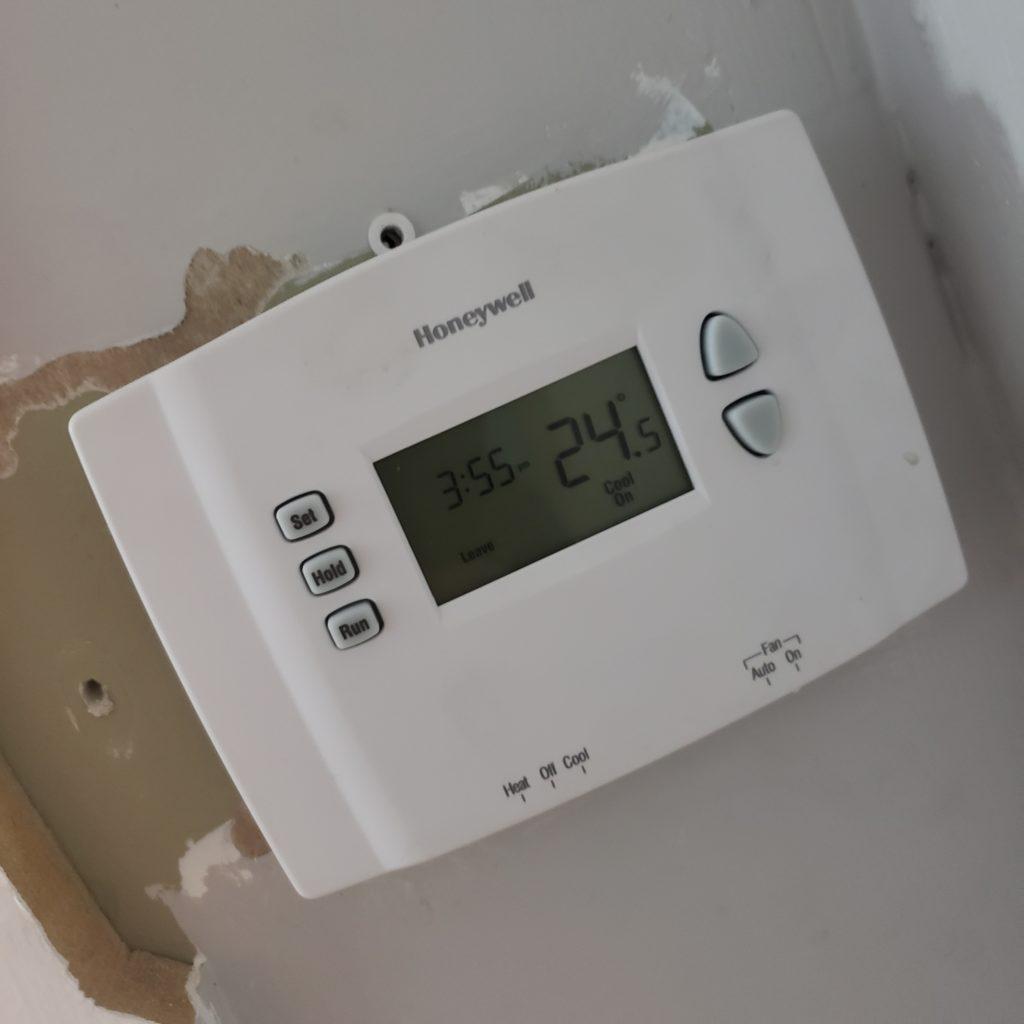
On the hottest day in July, we worked on cleaning a furnace that was only blowing hot air. The thermostat said it was set for 24°C, however there was no AC coming into the office.
I still have to rely sometimes on my father (founder of Vacu-Man Furnace and Duct Cleaning) for advice on this stuff.
At first we thought it was the compressor, which put me into a heart attack thinking it was going to cost thousands of dollars to repair.
Good news — it wasn’t the compressor. After 6 hours of cleaning and getting it looked at, my father advised that the owners should go buy a $30 simple thermostat.
The customer did at the end of the day, and sure enough, it worked. They were using the ecobee3 Lite as the smart thermostat, and sure enough this was a problem many people run into when they try to self-install it.
Why DIY Smart Thermostat Installs Fail: The C-Wire Problem
The Missing Wire Behind Most Failures
Most smart thermostat failures on older furnaces come down to one part: the C-wire, or “common wire.” Older thermostats only needed power occasionally, so many homes built before the smart thermostat era never had one wired in.
Why It Matters for Smart Devices
Smart thermostats need continuous power to run their Wi-Fi, touchscreen, and app connectivity — and without a C-wire, they can draw power in ways that confuse or shut down the furnace’s control board entirely. This is exactly what can happen with devices like the ecobee3 Lite: it’s a straightforward install if your system already has a C-wire, but on older equipment without one, a self-install can leave your furnace blowing hot air, cycling incorrectly, or not turning on at all — the kind of call we get most often in Hamilton, Burlington, Milton, and Brantford.
DIY vs. Professional Installation: When Each Makes Sense
When DIY Is Usually Fine
DIY is usually fine when your home already has a C-wire, your system is a standard single-stage gas furnace or central AC, and you’re comfortable working with low-voltage wiring.
When to Call a Pro
Call a pro when you don’t have a C-wire, your system is multi-stage, dual-fuel, or zoned, you have a heat pump, or you’re not 100% sure what you’re looking at behind the old thermostat.
The Red Flag to Watch For
If your furnace stops responding correctly within days of a self-install, that’s the thermostat — not the compressor — until proven otherwise.
How Much You Can Actually Save With an ENERGY STAR Smart Thermostat
The Real Savings Number
According to Natural Resources Canada, a properly working smart thermostat can save the average household close to 8% on annual heating and cooling costs — since space heating and cooling makes up roughly two-thirds of a typical home’s energy use. That’s a meaningful number, but it only holds up if the thermostat is actually installed correctly and communicating properly with your furnace.
Why Certification Matters
NRCan specifically recommends choosing an ENERGY STAR certified connected thermostat, since these models are independently tested to confirm they deliver the savings they claim. A smart thermostat that’s fighting compatibility issues on old wiring isn’t just a comfort problem — it can quietly erase the energy savings it was supposed to provide.
Ontario Rebates for Smart Thermostats
The Current Program
As of 2026, Enbridge Gas and the IESO’s Save on Energy program jointly run the Home Renovation Savings smart thermostat rebate, offering an instant rebate (currently $75–$100 depending on retailer) on qualifying ENERGY STAR certified smart thermostats for Ontario homes.
Who Qualifies
To qualify, you generally need to be an Enbridge Gas customer or be connected to the Ontario electricity grid, purchase an eligible model, and apply within 60 days of purchase. Details and eligibility can change, so it’s worth confirming current terms directly on the program’s website before buying.
Smart Thermostat Installation in Hamilton, Burlington, Milton & Brantford
What Professional Installation Costs
If you’re upgrading your thermostat in our service area, professional installation typically runs in the $150–$300 range depending on the brand and whether extra wiring or a C-wire adapter is needed — often a smaller cost than the rebate makes it sound once you factor in avoiding a failed DIY install.
Get It Checked Before You Buy
Vacu-Man’s gas techs can check compatibility with your specific furnace before you buy anything, so you’re not stuck troubleshooting an incompatible unit later.
We check compatibility for Nest, ecobee, and Honeywell smart thermostats before you buy — so you know exactly what your furnace needs before it’s on the wall.
Do Popular Smart Thermostats Need a C-Wire?
| Brand / Model | C-wire situation |
|---|---|
| ecobee3 Lite | Requires a C-wire, or a wired-in power extension kit if your system doesn't have one |
| Google Nest (Learning, Nest E) | Often runs on power-stealing without one, but Google recommends a C-wire or Nest Power Connector — especially on zoned or heat-pump systems |
| Honeywell T5/T6 Pro Wi-Fi | Requires a C-wire to power the Wi-Fi and display |
| Honeywell T9 | Ships with its own C-wire adapter, so it works without an existing C-wire |
This is exactly the kind of thing our techs check for free before you buy — see below.
FAQ
Can I install a smart thermostat myself?
Yes, if your home already has a C-wire and a standard furnace setup. If you don’t have a C-wire or have a more complex system, professional installation is safer and avoids furnace downtime.
Why did my furnace stop working after installing a smart thermostat?
The most common cause is a missing or incompatible C-wire, which can disrupt power to the furnace’s control board. This is often mistaken for a compressor failure.
How much does professional smart thermostat installation cost in Hamilton?
Typically $150–$300 installed, depending on the brand and whether additional wiring is required. Some installations qualify for provincial rebates.
Is a basic thermostat better than a smart thermostat on an older furnace?
Sometimes — a basic thermostat can be more reliable on older equipment that lacks a C-wire or has non-standard wiring, avoiding compatibility issues altogether.
How much money does a smart thermostat actually save?
According to Natural Resources Canada, a properly installed, ENERGY STAR certified smart thermostat can save around 8% on annual heating and cooling costs.
In Summary
Make sure that you get a professional tech to help with the installation. Vacu-Man only employs gas techs for working on these units, but you want to call a heating and cooling tech to properly install these new smart devices on older furnace units to ensure it’s done right!