
How Wildfire Smoke Gets Into Your Home and What Actually Helps
Wildfire smoke gets into your home through open doors and windows, small gaps around them, and your HVAC system’s fresh-air intake. The most effective protection is a MERV 13 furnace filter with the fan running, sealing obvious gaps, and a portable air cleaner in the main room. Duct cleaning helps once the smoke season ends.
How does wildfire smoke get into your home?
Wildfire smoke enters through three main paths: open windows and doors, the small gaps and cracks around them and through the building envelope, and any fresh-air intake on the HVAC system. The fine particles in smoke are small enough to slip through openings that feel sealed, which is why homes fill with a haze even when everything is shut.
The particles that matter most are called PM2.5, meaning they are 2.5 microns across or smaller. At that size they drift through tiny gaps and stay suspended in the air for a long time. Health Canada identifies wildfire smoke as one of the most serious air quality problems Canadians face, and because the particles are so fine, keeping them out entirely is difficult. The realistic goal is to reduce how much gets in and to filter what does.
Why is wildfire smoke a health concern?
Wildfire smoke is a concern because the fine PM2.5 particles penetrate deep into the lungs. Health Canada notes the effects are felt most by small children, pregnant people, older adults, and those with heart or lung conditions. Reducing indoor exposure during a smoke event is a sensible precaution for any household, not only high-risk groups.
This is a factual air-quality issue rather than a reason for alarm. The practical takeaway is simple: during a smoke event, the indoors should be cleaner than the outdoors, and a few steps make that reliably true. Checking the Government of Canada’s Air Quality Health Index for your area each day helps you decide when to take those steps and when to limit time outside.
Does closing the windows keep the smoke out?
Closing windows and doors helps, but it is not enough on its own. Smoke still enters through gaps around windows and doors, through the building envelope, and through any HVAC fresh-air intake. Closing up is the first step, but filtering the air inside is what actually lowers the particle level once smoke has found its way in.
It also helps to avoid pulling smoke in. Bathroom and kitchen exhaust fans vent indoor air outside, which creates negative pressure that draws outdoor air, and smoke, in through every crack, so it is best to limit their use when smoke is heavy. The same goes for whole-house or attic fans. Sealing obvious gaps with weather stripping makes the closed-up home more effective.
What furnace filter is best for wildfire smoke?
A MERV 13 furnace filter is the recommended choice for wildfire smoke, run with the system fan switched to on rather than auto so air passes through the filter continuously. MERV 13 captures a meaningful share of the fine PM2.5 particles in smoke, far more than the basic panel filters most homes use by default.
Both Canadian and American authorities point to this level. Health Canada’s cleaner-air guidance recommends filters rated MERV 13 or higher during smoke events, and the US EPA likewise recommends at least a MERV 13 rating, or as high as the system can handle. One caution: not every furnace can handle a MERV 13 filter, because the denser media restricts airflow. Older or smaller blowers may struggle, so it is worth confirming your system can accommodate one. Vacu-Man supplies MERV 13 furnace filters for homes whose systems can take them.
Do portable air purifiers help with wildfire smoke?
Yes. A portable air cleaner with a HEPA filter, placed in the room where your household spends the most time, is one of the most effective tools during a smoke event. It filters the air in that specific room continuously, creating a cleaner space to retreat to when outdoor air quality is poor.
Health Canada’s cleaner-air-spaces guidance recommends portable air cleaners as a core strategy for sheltering at home during wildfire smoke. Size the unit to the room, follow the manufacturer’s placement and maintenance instructions, and avoid ozone-generating devices, which are not appropriate for occupied rooms. Between a MERV 13 furnace filter moving whole-home air and a HEPA purifier in the main room, most households can hold indoor particle levels well below the outdoor peak.
Should I change my filter more often during smoke?
Yes. Wildfire smoke loads a filter far faster than normal household dust, so a filter that would last three months can clog in weeks or less during a heavy smoke event. A clogged filter restricts airflow and stops working well, so check it often and replace it as soon as it darkens.
It is worth keeping spare MERV 13 filters on hand before smoke season, because store shelves empty quickly once a major event begins. Because good ventilation and filtration are central to indoor air quality, a fresh filter during a smoke event is doing real work, and a clogged one is not. Watching how quickly the filter darkens is a useful, visible sign of how hard your system is working.
Does duct cleaning help with wildfire smoke?
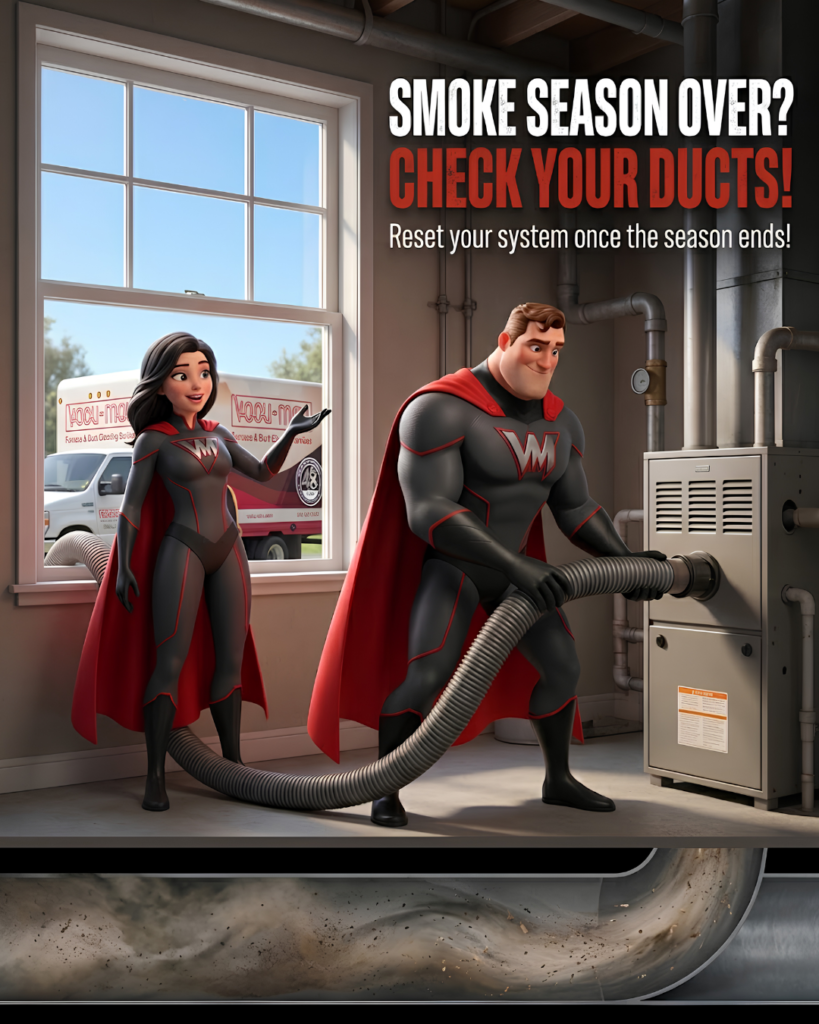
Not in real time. Duct cleaning does not filter incoming smoke while a fire is burning; that is the job of filters and purifiers. Where cleaning helps is afterward: a heavy smoke season leaves fine particulate settled throughout the duct system, and a professional cleaning removes that residue so it is not recirculated for months after the air clears.
Think of it as the recovery step. During the event, focus on filtration, sealing, and a clean-air room. Once the smoke season ends, clearing the settled particulate from the ducts, blower fan, and coil gives your system a clean baseline again and removes any lingering smoke odour held in the ductwork. Starting a smoke season with a clean system also means the filter is not fighting existing buildup on top of the smoke load.
What should I do after wildfire season?
After a smoke season, replace the overloaded furnace filter, wipe and damp-mop settled dust rather than dry-vacuuming it, and consider a professional duct cleaning to remove the fine smoke particulate that has settled inside the system. This resets your indoor air for the months ahead.
A full furnace and duct cleaning at Vacu-Man is $399 for a typical home up to about 2,200 square feet, with each additional vent $10 plus HST. Prices are current at publishing and subject to change, so contact us for a quote. The residential pricing page shows what is covered, and the air duct cleaning process page explains how the smoke residue is removed. Homeowners booking a duct cleaning in Grimsby or a duct cleaning in St. Catharines can schedule once the season settles.
Frequently Asked Questions
Can I run my air conditioning during wildfire smoke?
Yes, and it helps. Running the system with a MERV 13 filter and the fan set to on keeps filtering indoor air, and air conditioning also lowers indoor humidity. If your system has a fresh-air intake or economizer that pulls in outdoor air, set it to recirculate during heavy smoke so it is not drawing smoke inside.
Is a MERV 13 filter safe for my furnace?
Usually, but not always. MERV 13 media is denser and restricts airflow more than a basic filter, which some older or smaller blower motors cannot handle without strain. Check that your system can accommodate one, and if you are unsure, have a professional confirm the highest-efficiency filter your furnace can safely run.
Does duct cleaning remove wildfire smoke from the air?
Not while smoke is active. Real-time protection comes from filtration and portable air cleaners, not duct cleaning. What a cleaning does is remove the fine smoke particulate that settles inside the ductwork after a heavy smoke season, so your system is not recirculating it, and any smoke odour held in the ducts is cleared.
Be Ready Before the Next Smoke Season
Wildfire smoke is now a regular part of Ontario summers, and a little preparation makes a real difference. Contact Vacu-Man about MERV 13 filters for your system and a post-season duct cleaning to clear settled smoke particulate. Vacu-Man’s certified, TSSA-licensed technicians have served Hamilton and the surrounding area for over 45 years. Call 905.333.5454 or visit vacuman.com.
You cannot stop the smoke outside. You can decide how much of it you breathe inside.