
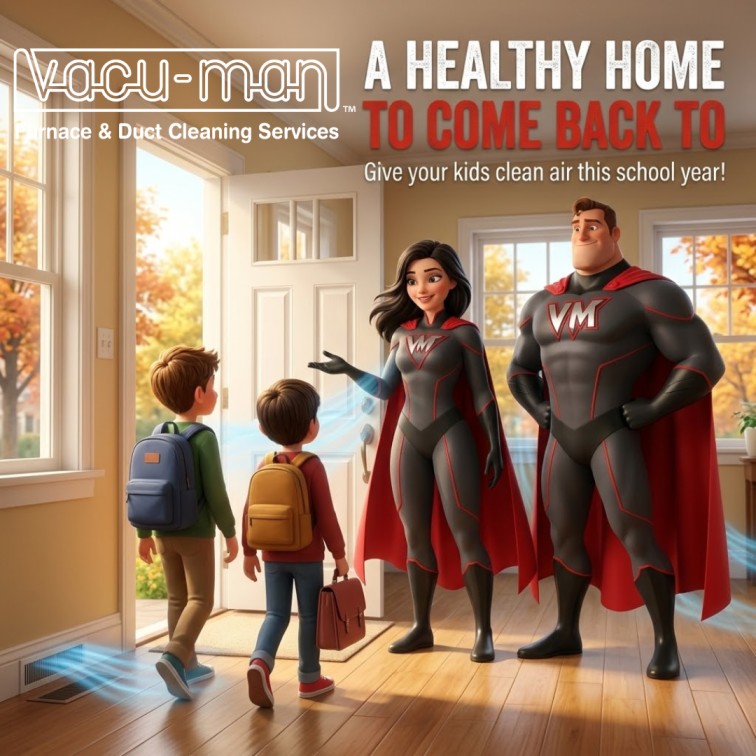
Back to School: Protecting Your Family from Indoor Allergens
Back to school season is a busy time. New routines, packed schedules, and the shift from long summer days outdoors to more time spent inside. For families across Hamilton, Burlington, and Oakville, it is also the point in the year when kids start spending more of their day indoors, which makes the quality of the air inside your home more important than most parents realize.
As the season turns, ragweed pollen is peaking, the furnace is about to come on, and the household is settling back into an indoor routine. All of that puts a spotlight on indoor allergens, and on the duct system that circulates them through every room where your family sleeps, eats, and does homework.
Why Children Are More Vulnerable to Indoor Allergens
Children are not simply small adults when it comes to air quality. According to the Government of Canada’s guidance on air quality and children’s health, infants and children are especially susceptible to the health effects of air pollution because their bodies are still growing, their lungs are still developing, and they breathe in more air per kilogram of body weight than adults do.
This matters because indoor air pollutants, including dust, pet dander, mould spores, and pollen, can trigger asthma attacks and cause respiratory symptoms like coughing and throat irritation even in otherwise healthy children. Asthma Canada notes that young children are among those at greatest risk from poor air quality, and that air pollution is a key trigger for asthma and associated allergies.
For a child with allergies or asthma, the quality of the air in the home directly affects their comfort, their sleep, and their ability to focus during the school year.
The Indoor Shift That Comes With the School Year
Summer keeps everyone outdoors and windows open. The school year reverses that. Kids come home and settle in for homework, screen time, and earlier bedtimes, all indoors. As the weather cools, windows close and the furnace comes on, sealing the home into a recirculating environment.
This shift concentrates indoor allergens. Whatever is in the ductwork, the dust, dander, pollen, and debris accumulated over the summer, gets circulated continuously through a sealed home rather than diluted by fresh air. Vacu-Man’s post on the connection between contaminated ductwork and allergen exposure documents exactly how this recirculation exacerbates allergic reactions and reduces respiratory health, and it becomes most relevant precisely when the household moves back indoors for the season.
The Ductwork Connection
Your duct system is the pathway for every bit of conditioned air in your home. When it is clean, it delivers clean air. When it is loaded with a summer’s worth of accumulated allergens, it delivers those into every room each time the system runs.
As Vacu-Man explains in its post on fall allergy relief through clean ducts, air ducts collect dust, pollen, pet dander, and mould spores over time, and these particulates become airborne whenever the system runs, triggering sneezing, congestion, and asthma flare-ups. For a household with school-age children, that recirculation is happening in the same rooms where kids are doing homework and sleeping.
The blower fan is a particular concentration point, since allergen-loaded debris builds up on the blades and gets re-suspended every time the system cycles. When the furnace comes on for the first time in the fall, that accumulated material gets pushed through the entire home.
Protecting Your Family Through the School Year
The most effective single step is a professional duct cleaning, which removes the accumulated allergens from the system before the household settles indoors for the season. Vacu-Man’s full cleaning process reaches the duct runs, the blower fan, and the AC coil, clearing out the reservoir of allergens that would otherwise recirculate all fall and winter.
Beyond the cleaning, practical habits support cleaner indoor air. Changing the furnace filter on schedule keeps airflow clean and unrestricted. Washing bedding regularly in hot water reduces dust mites in the rooms where kids spend the most time. Keeping indoor humidity controlled limits both dust mites and mould. Using mechanical ventilation and air conditioning rather than opening windows during peak pollen periods keeps outdoor allergens out.
None of these replaces a clean duct system, but together they create a home environment that supports your family’s health through the demanding school year. A full furnace and duct cleaning starts at $399. See the residential pricing page for full details.
Give Your Family a Healthy Home to Come Back To
The school year is demanding enough without a home that quietly works against your family’s health. Clean air is one of the simplest, most lasting things you can provide for kids heading into a busy season of learning and growing.
Contact Vacu-Man today to book a cleaning that protects your family’s air as the school year begins. Vacu-Man’s certified HVAC professionals have been serving Hamilton, Burlington, Oakville, Mississauga, and Brantford for over 45 years. Call 905.333.5454 or visit vacuman.com to book.
Kids bring home enough from school. The air in your house should not add to it.